

Overview
The Logs add-on, once enabled, will send logs from pods running on the cluster, and optionally, Kubernetes audit records, to Control Plane. This will allow you to query the logs and audit records from your clusters managed by the Control Plane centrally in the web UI or in Grafana.Supported Providers
How to Enable
The Logs add-on can be enabled for your Kubernetes cluster either during the cluster creation process or at any time thereafter. The following sections outline the methods for enabling the add-on:At Cluster Creation
-
Through Cluster Manifest: Add the following snippet to your cluster manifest when creating the cluster:
YAML
-
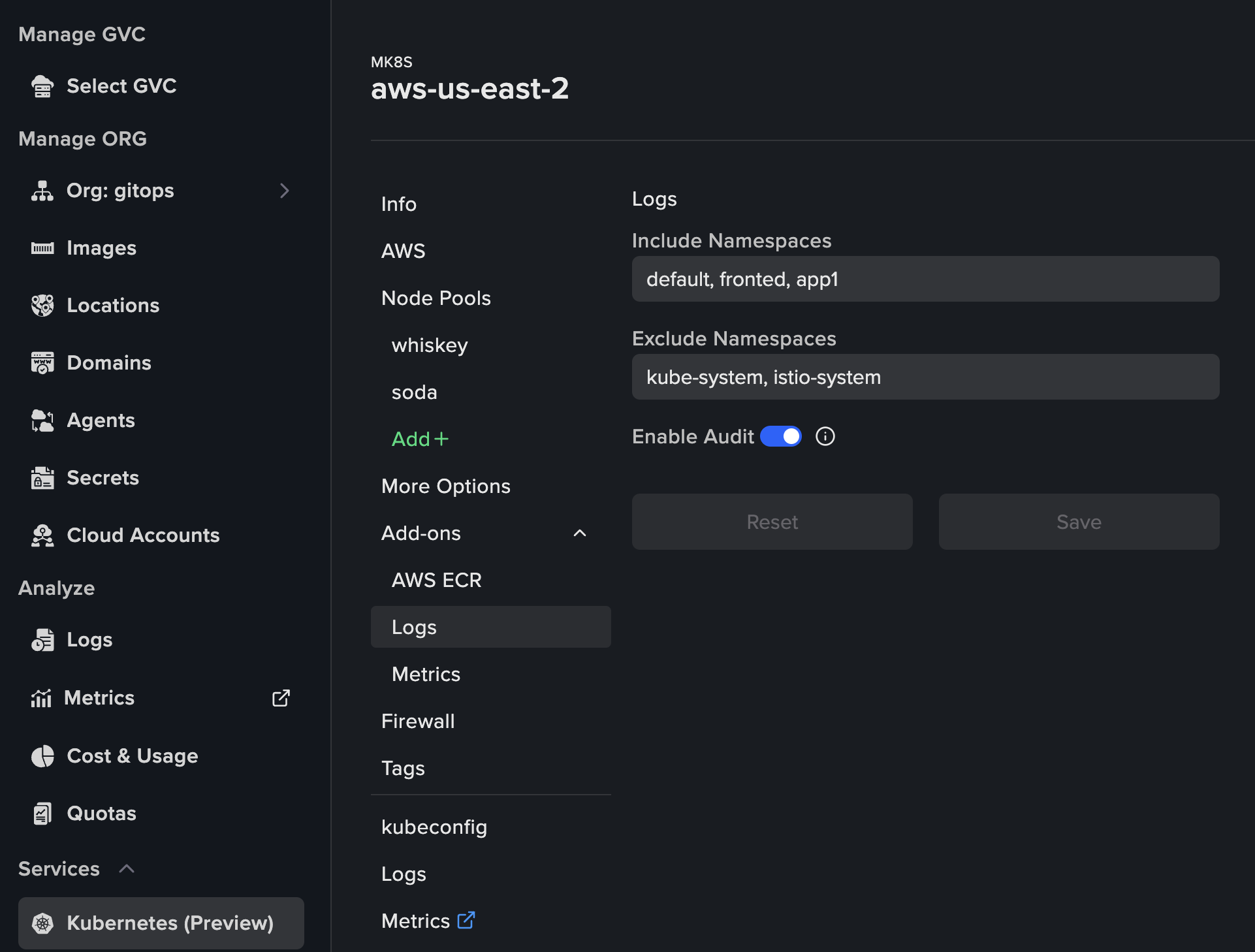
Using the Console: If you’re creating the cluster through the console, navigate to
Add-ons, find theLogsadd-on in the list of available add-ons, and toggle it on.
After Cluster Creation
If the Logs add-on was not enabled during the cluster creation, you can still enable it using either of the following methods:Using Manifest
Underspec.addOns in the YAML manifest of the cluster, you can edit it either by navigating to the cluster in the Console and using the Edit & Apply option for the cluster, or by applying the entire manifest using the cpln apply >_ option in the upper right corner or by using the cpln CLI.
Add the following:
YAML
Using UI
- Navigate to Control Plane Console: Visit the Control Plane Console.
- Navigate to the Kubernetes cluster: In the Control Plane Console, navigate to
Kubernetesin the left sidebar panel and click on the Kubernetes cluster for which you want to enable logging. - Enable Logs: Choose
Add-onsand locate theLogsadd-on from the list of available add-ons, then toggle it on.
Configuring Logs add-on
The configuration is optional. All settings are off or unrestricted when omitted. You can configure the following:
Pod logs from the cluster are always collected. Pods that belong to Control Plane workloads are not included, and neither are the logs of the collector itself.
Namespace filters
includeNamespaces and excludeNamespaces are regular expressions (RE2 syntax) that are matched against the whole namespace name, so app does not match app1. To match several namespaces, use alternation, for example default|frontend|app1. A comma separated list is not a list of names.
When both are set, a namespace must match includeNamespaces and must not match excludeNamespaces. The filters apply to pod logs only. They do not affect kubelet, kernel, docker or audit logs.
Node logs
kubeletandkernelread the systemd journal in/var/log/journalon each node. Only the last 4 hours are read when collection starts.kubeletreads thek3s-agent.serviceunit. The cluster’s control plane is hosted by Control Plane, so every node runs the k3s agent and is covered.dockerhas no effect on nodes that do not run Docker, because it reads the Docker socket at/var/run/docker.sock.
YAML
Analyzing Logs
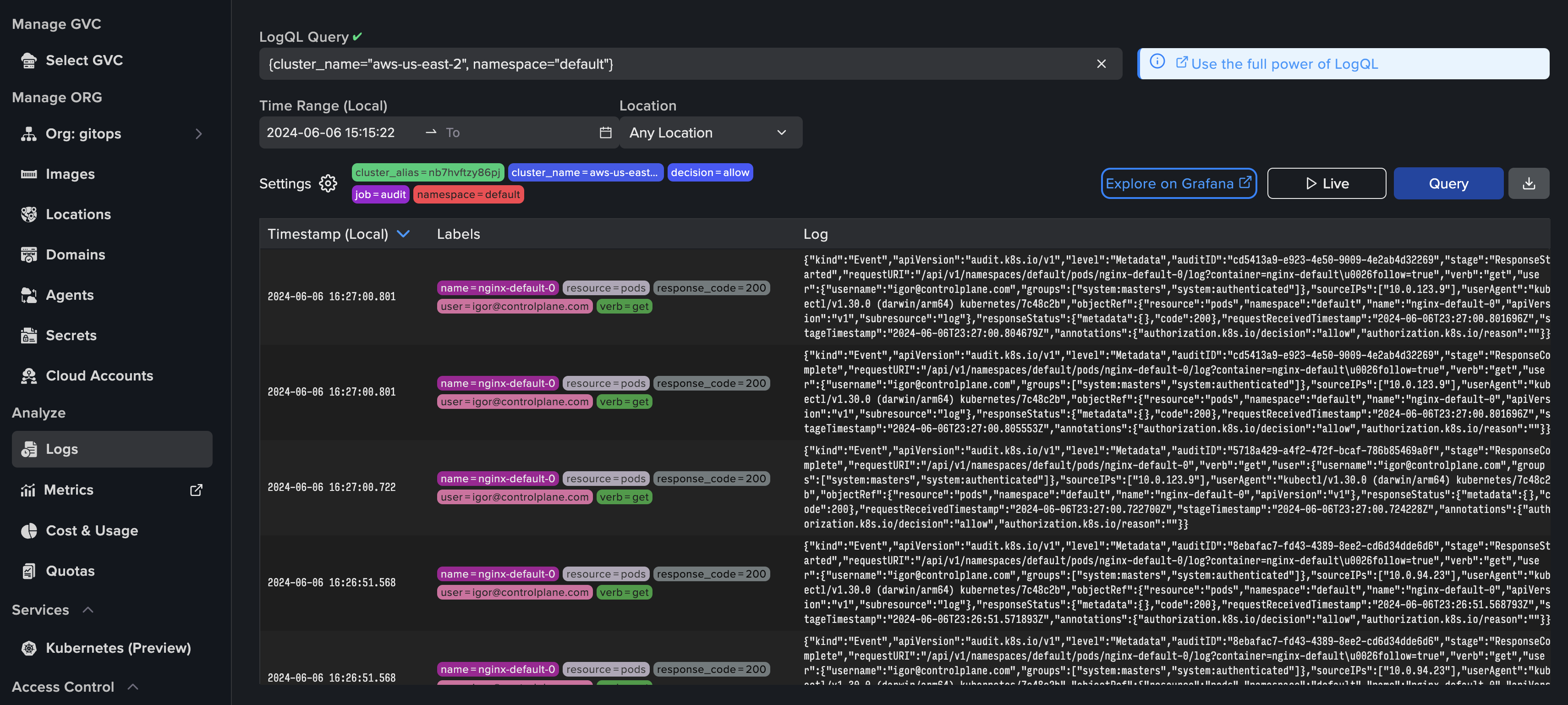
Once enabled, you can analyze the logs and audit events. For LogQL query examples and Grafana integration, see the Logs documentation.- Navigate to Control Plane Console: Visit the Control Plane Console.
- Analyze logs: In the Control Plane Console, navigate to
Logsin the left sidebar panel.
Use LogQL for query. Example query:{cluster_name="aws-us-east-2", namespace="default"}
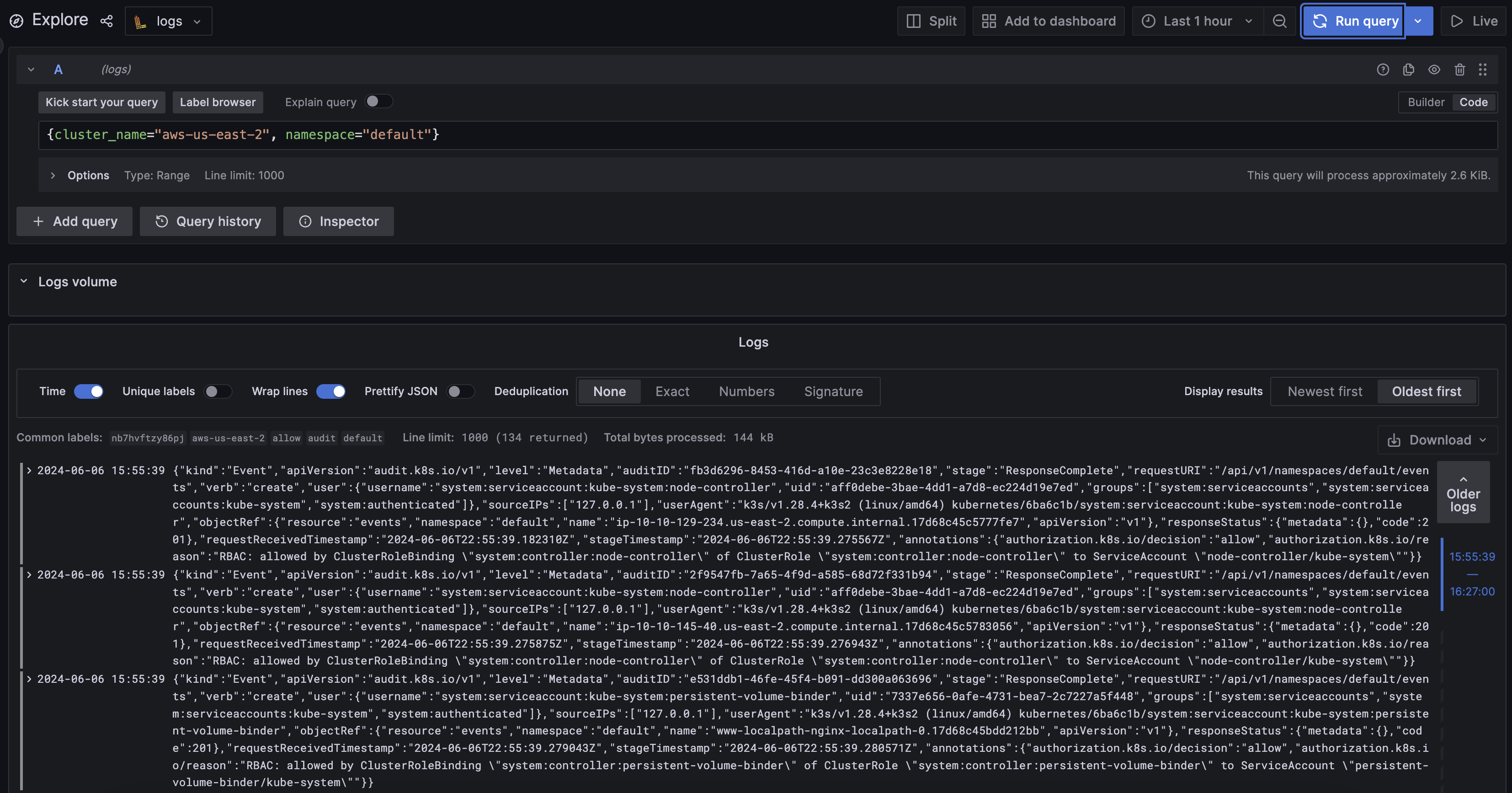
Explore On Grafana and analyze logs in Grafana:
Labels
Every log line carries thecluster_name and cluster_alias labels. The source is identified by the job label:
Audit records of Kubernetes system components and nodes, such as
system:kube-scheduler and system:node:*, are not collected.
Example queries: